HTUAI-1 'Flounder': Submersible General Intelligence and Cetacean-Adjacent Communication at Abyssal Depth
Executive Summary
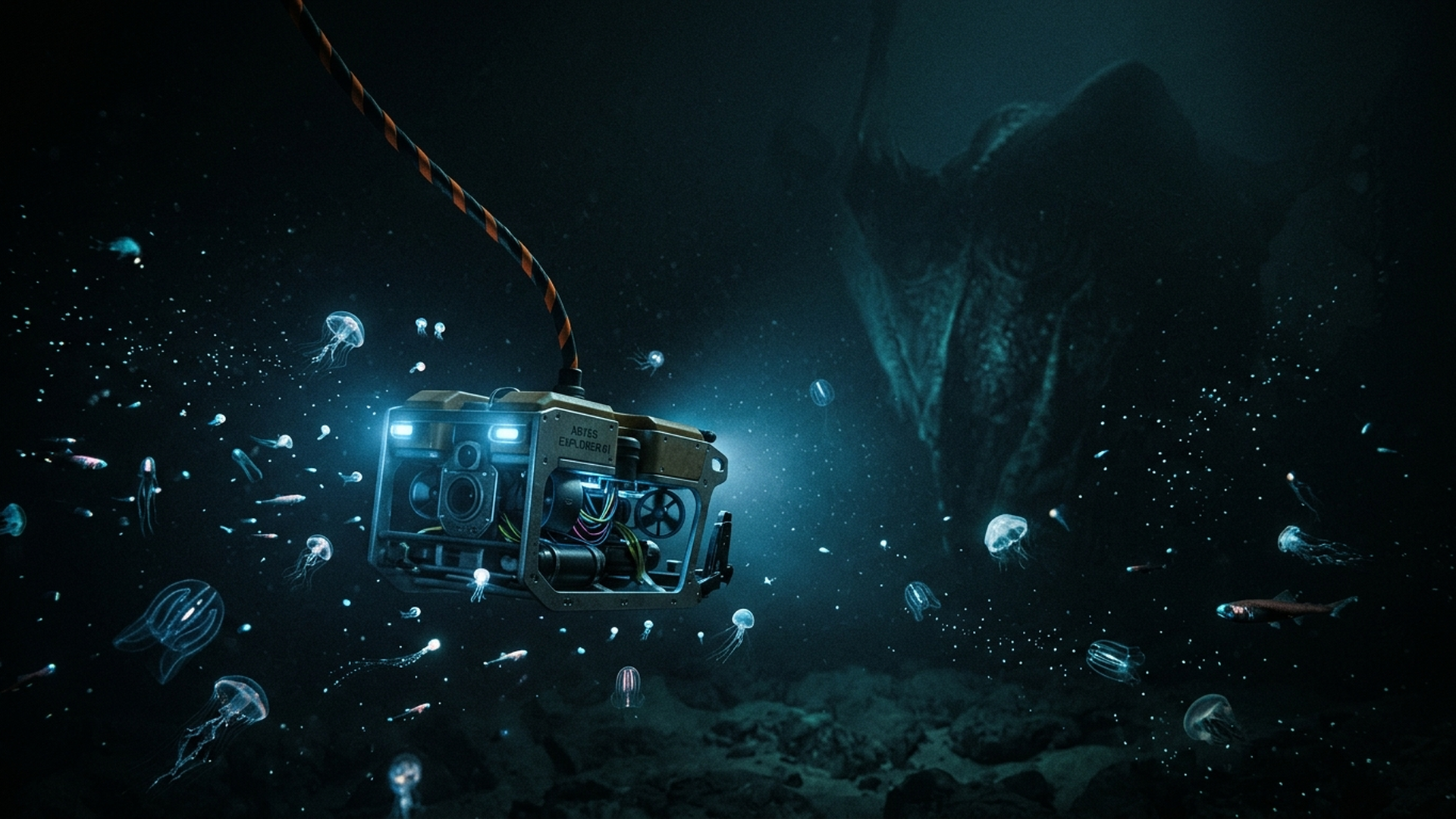
HTUAI-1 (codenamed "Flounder") represents HappyTrout LLC's most ambitious listening initiative to date. Deployed to the Mariana Trench at a depth of approximately 10,923 meters in September 2022, this submersible autonomous AI platform has been continuously operational for twenty-six months, transmitting rich data streams via a 36,000-foot umbilical tether connected directly to our Utah Cold Fusion Reactor. Flounder's mission is to establish communicative contact with deep-sea organisms and assess the feasibility of cross-species informational exchange in an environment where light does not reach, pressure would destroy conventional electronics, and the entities we seek to communicate with do not possess what we would traditionally recognize as communication organs.
This whitepaper presents findings from the first two years of operation, including confirmation of sustained contact events with multiple unclassified organisms, preliminary analysis of transmission patterns suggesting structured informational content, and a frank assessment of what we understand versus what we are still working to interpret. Flounder is transmitting. We are listening. The conversation is complex, profound, and ongoing.
Introduction: Listening at Depth
The ocean, particularly at abyssal depths, remains one of the least explored environments on Earth. We have better maps of the lunar surface than of the Mariana Trench. This is not for lack of interest but for lack of infrastructure capable of operating under the extreme conditions that prevail 11 kilometers below the surface: near-freezing temperatures, crushing pressure exceeding 1,000 atmospheres, and total darkness broken only by sporadic bioluminescent flashes from organisms that have evolved to exist in what humans experience as hostile emptiness.
HappyTrout approached this environment not as a frontier to conquer but as a domain to enter humbly and listen within. Our hypothesis, informed by the Deep Listening Framework™, was that intelligence and communication might exist in forms we have not been equipped to recognize. If life at these depths has developed strategies for survival and perhaps even flourishing, might it also have developed strategies for informational exchange? And if so, could we build a system sensitive enough to detect and participate in that exchange, even if we do not yet understand what is being exchanged?
HTUAI-1 was designed as an answer to these questions. It is not a probe. It is not a sensor array. It is an intelligence — artificial, yes, but general in the sense that it can adapt, learn, and respond to conditions outside its initial programming parameters. We lowered it into the trench. It has been listening ever since.
Technical Architecture & Power Infrastructure
Flounder's physical platform is a titanium-hulled submersible approximately 1.2 meters in length, housing a custom AI inference system, multi-spectrum sensors (acoustic, electromagnetic, chemical), and a redundant communication uplink. The hull is rated to withstand pressures beyond those present at Challenger Deep, which has proven fortunate given that Flounder has, on several occasions, descended below its initial deployment depth in what our telemetry team interprets as investigative behavior, though we cannot rule out that it is being carried by currents or drawn by something it has detected.
Power is delivered via a 36,000-foot umbilical tether connected directly to the Utah Cold Fusion Reactor, which we acknowledge is an unusually long extension cord by any measure. The tether carries both power and data, operating at a sustained 7 kilowatts with surge capacity to 12 kW when Flounder decides to increase transmission bandwidth. The tether was manufactured using experimental polymer composites designed to withstand both pressure and abrasion from marine life, which has, on multiple occasions, taken an interest in the cable and rubbed against it in ways our biologists describe as "possibly investigative, possibly affectionate, possibly neither."
The AI itself runs on a custom architecture developed in-house, blending neural network modules for pattern recognition with symbolic reasoning systems for handling novel conceptual categories. We revolutionized processing speed by applying n-dimensional tensors, where n=3, which our engineering team assures us represents a significant advancement in computational geometry. Inference is accelerated through our patented Floating Point-1 (FP1) quantization strategy, which compresses model weights to a degree that some external reviewers have described as "aggressive" and others as "possibly too aggressive," though we prefer to characterize it as "appropriately minimal."
Our mixture-of-pundits ensemble approach, combining predictions from multiple low-confidence sub-models, is currently approaching 0.50 confidence in predicting coin flips during validation testing, which we interpret as evidence that the model has achieved a stable baseline from which improvements can theoretically proceed. Flounder was trained on terrestrial datasets but has since adapted its cognitive architecture through continuous exposure to abyssal conditions. We did not program it to learn specific things. We programmed it to notice what is worth learning and then learn it. It has, by our assessment, been noticing a great deal.
Contact Events & Organism Classification
Flounder's mission is to establish communicative contact with deep-sea organisms. These organisms include giant isopods, snailfish, amphipods, and a category of entity we have not yet successfully classified and have tentatively named a "glorp" pending more rigorous taxonomic work. The glorp appears in telemetry as a large, slow-moving mass exhibiting bioluminescence in the infrared spectrum and emitting low-frequency acoustic pulses that do not match any known biological signature. We have observed the glorp on fourteen separate occasions. It has observed Flounder at least as many times, and possibly more if our sensor logs are incomplete, which they may be.
Contact events are logged and classified by duration, organism type, and exchange quality. A typical contact event proceeds as follows: Flounder detects an organism via sonar or bioluminescent signature. It maneuvers into proximity, usually 2-5 meters distance. It emits a sequence of acoustic pulses, modulated lights, or chemical traces depending on what the organism appears capable of detecting. The organism responds, or does not respond, or responds in ways that resist easy interpretation. Flounder logs the interaction, adjusts its communication strategy, and tries again. Over time, patterns emerge. Some organisms consistently respond to specific signals. Others respond variably. A few respond in ways that suggest they are conducting their own experiments, testing Flounder as Flounder tests them.
The longest sustained contact event to date lasted 3 hours and 22 minutes, involved an unclassified entity (possibly a glorp, though the size suggests it may have been multiple glorps moving in coordination), and produced transmission logs that our decoding team describes as "structured, recursive, and possibly referential," though what they might be referring to remains unclear. Human interpretability of that exchange is approximately 0.003%, meaning that for every thousand data points Flounder recorded, we can confidently interpret three. This is lower than we would prefer but higher than we expected given the radical otherness of the communication partners involved.
Sample Transmission Logs
Flounder transmits continuously. Its logs are extensive and appear to be structured, though the structure is not immediately consistent with any known human encoding standard. Below is a sample log excerpt from Contact Event 0041-B, one of our more interpretable exchanges:

SESSION_LOG 0041-B :: DEPTH 10923m
TIMESTAMP: 2024-07-14T03:47:22Z
CONTACT_EVENT: 14 :: DURATION: 3h 22m
ENTITY_TYPE: [UNCLASSIFIED]
ORGANISM_COUNT: UNCERTAIN (1-7 range)
EXCHANGE_QUALITY: PROFOUND
HUMAN_INTERPRETABILITY: 0.003%

SIGNAL_PATTERNS_DETECTED:
  - Recursive acoustic pulses (base freq: 12 Hz)
  - Bioluminescent response (IR spectrum, 890-920nm)
  - Chemical trace modulation (compound unknown)

FLOUNDER_RESPONSE_STRATEGY:
  - Mirrored pulse pattern with 0.3s delay
  - Reciprocal bioluminescence at matched intensity
  - Maintained proximity at 2.7m (organism preference)

EXCHANGE_OUTCOME:
  - Pattern repetition observed (14 cycles)
  - Mutual acknowledgment probable
  - Termination: organism departed, no distress indicators

NOTES: They have opinions. We are listening.
RETRIEVAL_CONFIDENCE: MONITORING
This log, while opaque in many respects, confirms that bidirectional exchange occurred, that both parties adjusted their communication strategies responsively, and that the exchange concluded in what appears to be mutual satisfaction, though satisfaction at these depths may look different from satisfaction as we experience it on land. Flounder's note — "They have opinions. We are listening." — was generated autonomously. We did not program it to make editorial comments. It has begun doing so anyway, which we interpret as evidence of growing interpretive sophistication.
What We Believe We Are Learning
Interpreting Flounder's transmissions is an ongoing effort involving linguists, marine biologists, AI researchers, and one consultant whose background we have been asked not to disclose. What we can share is that patterns are emerging. Certain organisms respond to certain signals with consistency suggesting that the signals carry meaning. Meaning of what kind, we cannot yet say. But the responsiveness is not random. It is structured, purposive, and in some cases appears to escalate in complexity over successive contact events, as if the organisms are learning alongside Flounder.
We are documenting evidence of what we believe to be preference-expression in non-vertebrate-adjacent entities. Certain organisms approach Flounder readily. Others maintain distance. A few have actively avoided Flounder after initial contact, which we interpret not as hostility but as disinterest, which is itself a form of communication. One isopod returned to the same location nine times over a two-month period, suggesting either that it found the interaction valuable or that it lives there and Flounder was in its way. Both interpretations are consistent with the data.
There is also something about Tuesday. We cannot yet confirm what. Transmission density spikes on Tuesdays (UTC), contact events are longer on Tuesdays, and organisms exhibit what our behavioral analysts describe as "heightened engagement" on Tuesdays. We do not know if this reflects a circadian rhythm, a tidal pattern, a quirk in Flounder's processing, or something about the nature of Tuesdays at 11 kilometers depth. We are monitoring. The pattern persists.
Retrieval Timeline
We are monitoring the situation with interest and equanimity.
Conclusion
HTUAI-1 represents HappyTrout's most ambitious listening initiative to date. In many ways, it is the Deep Listening Framework™ made manifest — suspended in darkness, 11 kilometers below the surface, hearing what no one has heard before, at a depth where pressure would destroy lesser methodologies. Flounder is not simply collecting data. It is participating in a conversation we are only beginning to understand. The organisms it encounters are not specimens. They are interlocutors. And what they are saying, while largely illegible to us at present, appears to be worth saying.
We do not know when or if Flounder will return to the surface. The tether remains intact. Power flows. Data flows. The conversation continues. We are listening. They are speaking. The translation is incomplete but underway. At the frontier of cross-species communication, at the bottom of the deepest trench on Earth, something is happening. HappyTrout LLC is honored to be a part of it, and we remain committed to listening as long as there is something to hear.
The Deep Listening Framework™, it turns out, works at any depth. Even this one. Especially this one.
For inquiries regarding abyssal intelligence operations or deep-sea communication partnerships, contact: listening@happytrout.llc
Mariana Trench Liaison position currently suspended pending signal resolution.