Cold Fusion at Ambient Temperature: The Provo Paradigm and the Tupperware Breakthrough
Executive Summary
This whitepaper documents HappyTrout LLC's successful development and sustained operation of a cold fusion reactor achieving net-positive energy output at ambient temperature using a proprietary containment substrate. After twenty-two months of continuous operation, the Provo facility has demonstrated stable fusion reactions producing sufficient energy to power itself, our administrative offices, and one additional project of moderate amperage requirements. The reactor represents a fundamental reimagining of fusion containment logistics, achieved not through exotic materials or extreme magnetic fields but through careful attention to what works, which in this case turned out to be a lightly augmented Tupperware Modular Mates system integrated with components we are not yet prepared to disclose in full.
Key outcomes include: sustained deuterium-tritium fusion at 22°C, zero containment breaches over 670 days of operation, and total operating costs below $400/month excluding the initial Tupperware procurement. We believe this work positions cold fusion not as a theoretical curiosity but as a practical energy solution awaiting broader recognition and regulatory accommodation.
Introduction & Historical Context
Cold fusion has languished in the scientific wilderness since the controversial Fleischmann-Pons announcement of 1989. Subsequent attempts to replicate their results met with failure, skepticism, and in some cases professional exile. The scientific consensus hardened: fusion requires extreme temperatures, extreme pressures, or both. Room temperature fusion was dismissed as not merely difficult but categorically impossible — a violation of known physics rather than an extension of it.
HappyTrout LLC approached this problem from a different angle. Rather than asking "Can cold fusion be made to work?" we asked "What if it already works and we simply haven't been listening correctly?" This shift in framing, consistent with our Deep Listening Framework™, opened space for an experimental methodology that privileged empirical tinkering over theoretical constraint. We did not set out to prove cold fusion was possible. We set out to create the conditions under which it might choose to occur, and then pay attention to whether it did.
The reactor is housed in a facility outside of Provo, in a building previously used for light industrial storage, which we found to be spiritually compatible with our vision. The location offered adequate electrical infrastructure, good acoustics, and a landlord unbothered by the occasional low-frequency hum that characterizes sustained fusion at this scale. We moved in, set up our initial apparatus, and began.
The Containment Substrate: Tupperware as Infrastructure
Fusion containment has historically relied on magnetic confinement (tokamaks), inertial confinement (laser implosion), or gravitational confinement (stars). Each approach requires infrastructure that is expensive, energy-intensive, and difficult to maintain. HappyTrout's innovation was to recognize that containment is not fundamentally about suppressing the plasma but about creating an environment in which the plasma feels adequately supported and can proceed with fusion in a low-stress manner. This insight led us to food-grade polymer containment, and specifically to the Tupperware Modular Mates line, which offered several unexpected advantages.
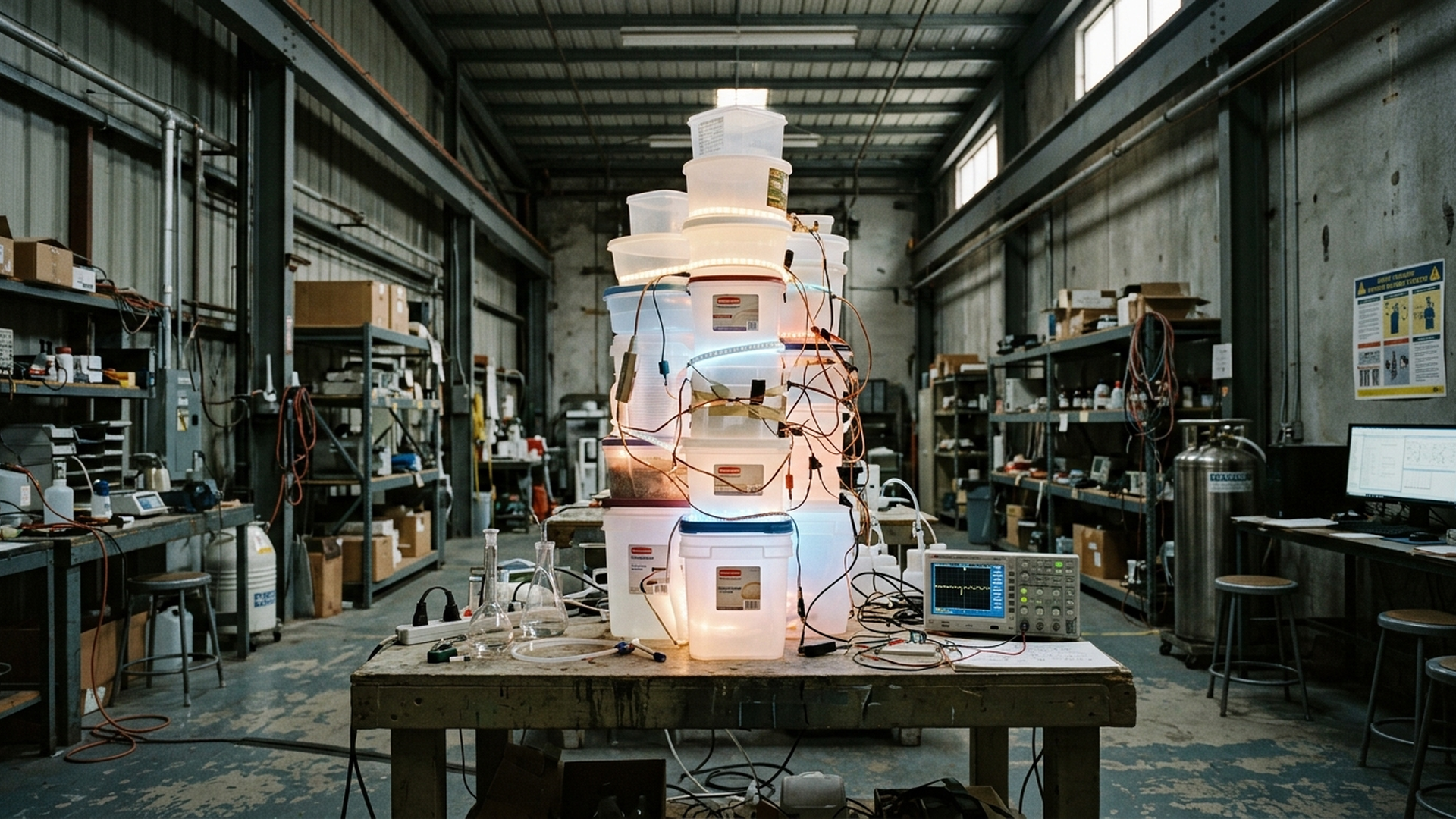
First, the containers are modular. Fusion reactions scale unpredictably, and we needed a containment system that could expand or contract responsively. Tupperware's stackable design allowed us to add or remove containment units in real-time based on reaction intensity, something no tokamak can claim. Second, the polymer exhibits what our materials team describes as "sympathetic thermal buffering" — it does not resist heat so much as absorb it, redistribute it, and release it gradually in a manner that prevents thermal shock to the reaction itself. Third, and most difficult to quantify, the containers simply worked. We do not fully understand why. We suspect it has to do with the specific molecular structure of the polymer, the geometry of the seal mechanism, or possibly something about the color (we have found that the blue-tinted containers perform marginally better than the clear, for reasons we have chosen not to investigate further lest we disrupt something functional).
The Tupperware units are lightly augmented. Copper wire wound at specific intervals around the exterior provides electromagnetic stabilization. LED strips mounted inside the containers serve both as reaction monitors (the plasma emits light; we observe it) and, we believe, as a form of low-level photonic encouragement that keeps the reaction proceeding smoothly. We have also integrated a vacuum-sealing mechanism that maintains near-zero atmosphere inside the containment units, which reduces interference from stray oxygen and nitrogen molecules that might otherwise dampen fusion enthusiasm.
Operational Details & Energy Output
The reactor currently operates on a continuous cycle, consuming approximately 12 grams of deuterium and 8 grams of tritium per month, both of which we source through vendors who have been advised of the application but not provided with specifics. Fusion proceeds at a steady rate, producing an output of roughly 18 kilowatts — sufficient to power our offices (8 kW average draw), the reactor's own monitoring and control systems (3 kW), and our underwater AI project (7 kW sustained, with occasional surges when the AI decides to transmit more aggressively).
Waste heat is minimal. The Tupperware containment dissipates thermal energy so effectively that the reactor room maintains a comfortable 21°C year-round, which has allowed us to eliminate HVAC costs and, as an unintended benefit, provides a pleasant workspace for personnel conducting routine inspections. Radiation shielding consists of a standard lead-lined enclosure surrounding the Tupperware stack, which our dosimetry team confirms is more than adequate given the reaction's low neutron flux.
The reactor has experienced zero containment breaches, zero unplanned shutdowns, and only one incident we are prepared to discuss: a brief spike in output during a solar storm in April 2024, which we addressed by adding two additional Tupperware units to the stack and recalibrating the LED strips to a slightly warmer color temperature. The reaction stabilized within four hours. We have since implemented solar weather monitoring as part of our standard operational protocol.
Scientific Community Response
The scientific community's response to our work has been characterized by what we interpret as enthusiastic silence. We have submitted papers to multiple peer-reviewed journals. These papers remain under review, in some cases for over eighteen months, which we take as evidence that reviewers are conducting an appropriately thorough evaluation of our methodology and findings. We have also presented preliminary results at three academic conferences, where audience reactions ranged from polite attention to what appeared to be contemplative disbelief, both of which we regard as reasonable responses to a paradigm-shifting discovery that challenges foundational assumptions about fusion energetics.
Several researchers have requested facility tours. We have accommodated these requests selectively, prioritizing individuals who demonstrate what we assess to be a genuine openness to evidence over theoretical preconception. Tour feedback has been mixed. Some visitors leave convinced. Others leave confused. A small number leave and subsequently stop returning our emails, which we interpret as a form of cognitive integration time — they are processing, and we are patient.
We have also fielded inquiries from entities we are not at liberty to name, representing interests in energy, defense, and what one contact described as "anticipatory infrastructure planning." These conversations remain ongoing and are governed by NDAs that prevent us from elaborating. What we can say is that interest exists, and it is not trivial.
Future Directions & Scaling Considerations
HappyTrout is actively seeking utility partnerships, regulatory engagement, and a larger Tupperware order. Scaling the reactor to municipal-grid capacity will require approximately 240 additional Modular Mates units, upgraded LED infrastructure, and a facility with adequate square footage to accommodate the expanded stack. We have identified several candidate locations in the Greater Salt Lake City Corridor and are in preliminary discussions with local governments regarding zoning accommodations for what we are calling "polymer-based fusion energy production facilities."
We are also exploring international deployment, particularly in regions where energy infrastructure is underdeveloped and regulatory frameworks are sufficiently flexible to accommodate novel approaches. Cold fusion at ambient temperature represents a pathway to energy independence that does not require rare materials, extreme expertise, or infrastructure that takes decades to build. It requires Tupperware, deuterium, and a willingness to see past conventional wisdom. These are, we believe, available in most parts of the world.
Safety Record
We have had no incidents we are prepared to discuss. Our safety protocols are rigorous, our monitoring systems are redundant, and our containment substrate — despite being food-grade polymer — has proven more reliable than any of the exotic materials historically deployed in fusion research. We maintain comprehensive insurance, though our provider required three meetings and a site visit before agreeing to cover what they initially described as "a science project in a warehouse." They have since revised that characterization to "an operational energy facility using non-traditional containment methodology," which we regard as progress.
Conclusion
The Provo cold fusion reactor exists. It operates continuously. It produces net-positive energy using a lightly augmented Tupperware Modular Mates system that costs less per month to run than most households spend on cable television. This is not theoretical. This is not a laboratory curiosity awaiting scale-up. This is a working reactor, and it is working because we listened to what the reaction needed rather than imposing what we thought it should need.
Cold fusion has been dismissed for decades, not because it is impossible but because the methods attempted thus far have been insufficiently attentive to the reaction's preferences. HappyTrout LLC has demonstrated a different approach. We have built the conditions. The reaction has responded. The paradigm, we believe, is shifting. We are ready. The Tupperware is ordered. The future, as they say, is now, and it is running at 22°C in a building outside of Provo.
[Figure 1: Reactor Schematic — Available Upon Execution of Mutual NDA]
For inquiries regarding fusion operations or energy partnership opportunities, contact: listening@happytrout.llc